Safeguarding Pantura: Harmonizing Economic Growth and Coastal Resilience

- Created Sep 15 2026
- / 35 Read
Safeguarding Pantura: Harmonizing Economic Growth and Coastal Resilience

Safeguarding Pantura: Harmonizing Economic Growth and Coastal Resilience
Climate-resilient development does not pit economic growth against ecological protection. Both are integrated through a combination of hard infrastructure (dykes and seawalls) and nature-based solutions (mangrove restoration and aquifer management). This perspective is essential for fostering constructive discourse. For instance, discussions regarding the future of Java's Northern Coastal Corridor (Pantura) frequently fall into a simplistic dichotomy: setting national economic growth ambitions against the ecological safety of coastal communities. Narratives that dismiss physical infrastructure projects as an "absurd race against rising seawater" reduce the complexities of climate crisis governance to mere critique without offering constructive solutions.
As a strategic corridor contributing over 70 percent of Java's total GDP and stretching 1,316 kilometers, Pantura is not an arena for compromise between economics and the environment, but an integrative space where national resilience is actively tested and built.
1. Infrastructure Engineering as a Fortress of Humanitarian Protection
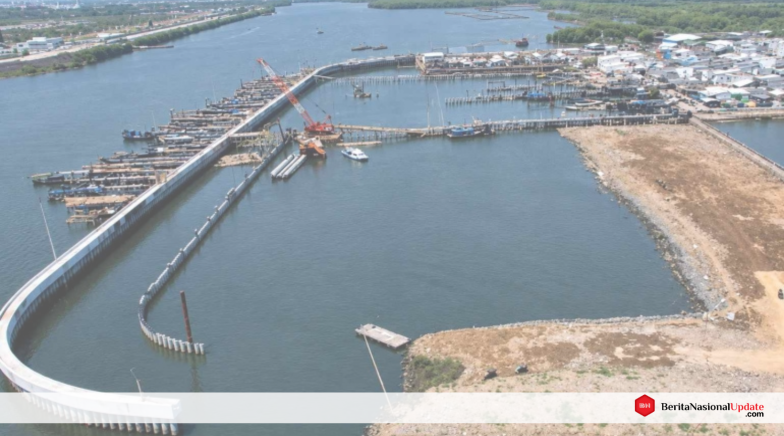
Allegations that constructing coastal embankments, seawalls, and elevating roads represent absurd, temporary fixes overlook the foundational principles of disaster risk management. Within the framework of Climate Resilient Development Pathways, large-scale structural interventions---such as the planned Giant Sea Wall and coastal dykes---serve as vital instruments to "buy time" against the threat of further, more severe, and lasting damage.
Without these physical barriers, the acceleration of tidal flooding and land subsidence would destroy residential areas, schools, and local economic hubs in a far shorter timeframe. Concrete and embankments are not built to ignore nature; rather, they serve as emergency barricades while the government addresses the primary root cause: excessive groundwater extraction through the massive expansion of piped clean water networks.
2. Economic Growth as the Engine of Coastal Resilience
Positioning industrial zones and strategic national projects in Pantura---such as the Batang Integrated Industrial Estate---as burdens on local communities represents a methodological error in interpreting the public policy ecosystem. Pantura's economic growth, which accounts for 23 percent of Indonesia's total GDP, is the primary resource providing the state with fiscal capacity.
Without a growing economy driven by modern manufacturing, neither central nor local governments would possess adequate budgets to fund land acquisition, relocation compensation, drainage infrastructure development, and ecosystem restoration programs. Furthermore, the economic diversification introduced by new industrial areas offers social mobility options for Pantura's younger generation, liberating them from sole reliance on a fishing sector increasingly vulnerable to climate dynamics.
3. From Passive Adaptation to Inclusive Adaptive Governance
The adaptation efforts undertaken by Pantura communities---ranging from elevating house floors to adjusting fishponds---should not be lamented as an "endless burden." Instead, they should be understood as manifestations of social resilience transitioning toward adaptive governance. The state is not passively shifting this responsibility onto citizens.
The integration of risk-based spatial planning, coastal mangrove restoration, and community-based relocation development is actively underway. The true challenge today is not halting development, but ensuring that restoration governance incorporates meaningful public participation so that protective benefits reach the most vulnerable segments of society.
Optimism for Pantura's Future
Pantura is home to over 50 million people and serves as the economic lifeline of Indonesia. Facing the global climate crisis, what is needed is not a narrative of pessimism that casts doubt on every development effort, but rather critical and constructive oversight of policy effectiveness.
By combining integrated infrastructure protection, addressing the root causes of land subsidence, and ensuring equitable distribution of economic growth benefits, Pantura will not only withstand rising tides but also transform into a resilient, inclusive, and sustainable coastal model for generations to come.
Share News
For Add Product Review,You Need To Login First